NOÉMIEGOUDAL
Supra Strata
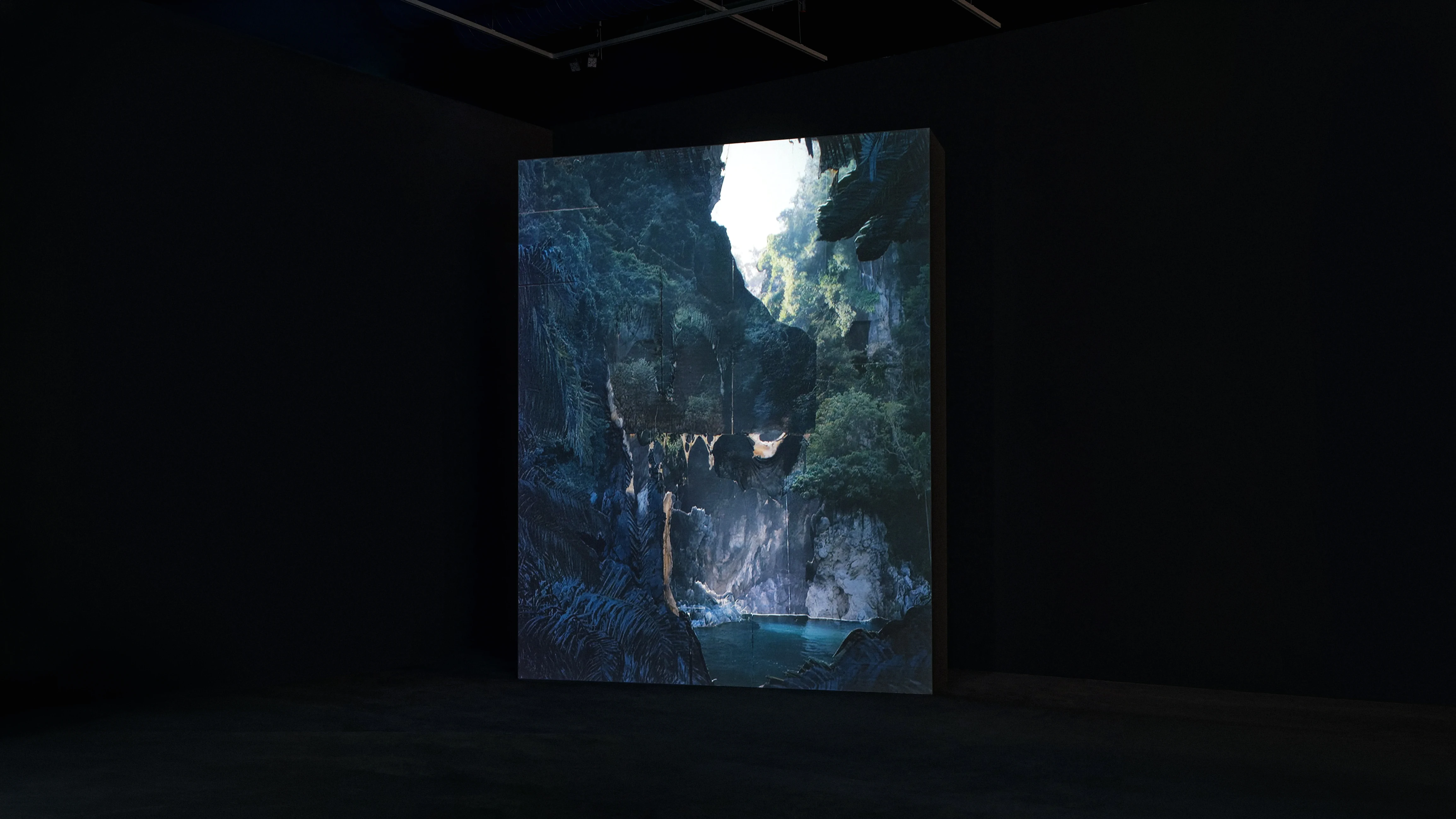
For her film Supra Strata, Noémie Goudal spent nearly six months finding materials she could dissolve on camera. She built a landscape from photographs mounted on black polystyrene, then applied acetone. As the supports soften and collapse, the photographs behind them become visible.
Constructing the view
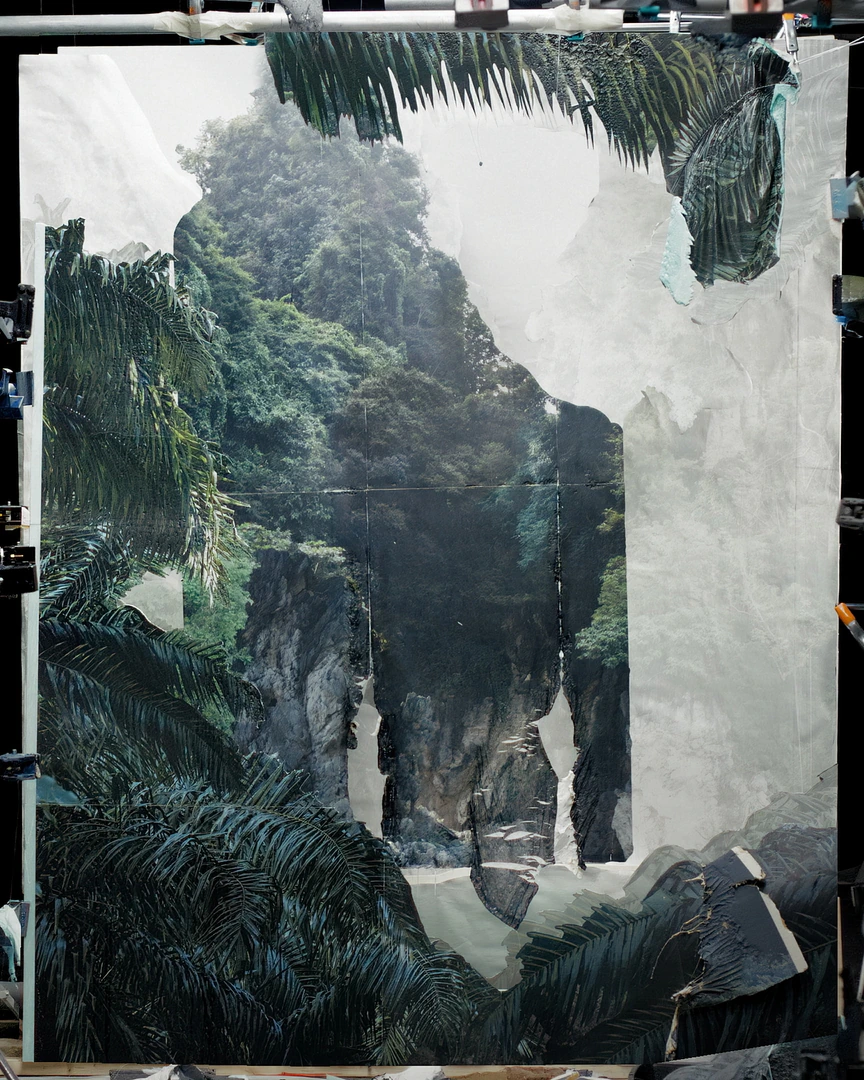
The studio photograph shows how much construction goes into the view. Printed foliage hangs in separate planes, surrounded by metal stands, ladders, cables, and lights. From the camera’s position, these flat pieces line up to give the landscape its depth. Seen from the side, there are narrow gaps between them and open space where the finished image suggests dense vegetation.
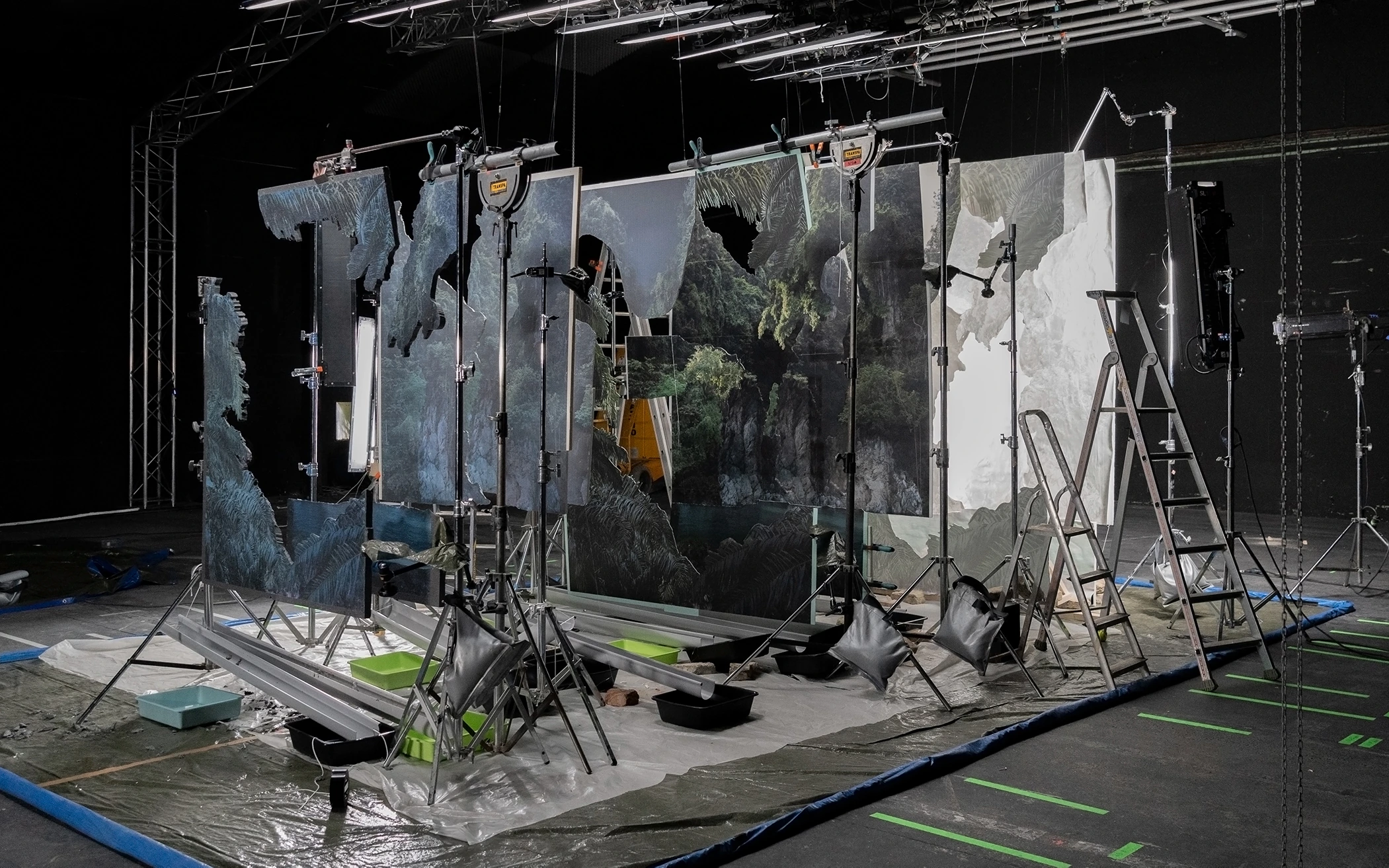
Goudal’s retoucher is also an optical engineer, who calculates the scale of the backdrops. Her longstanding cinematographer, Julien Malichier, helps build the sets as well as film them. In a conversation on the podcast Compelling, she describes how much of her work depends on this small, established team.
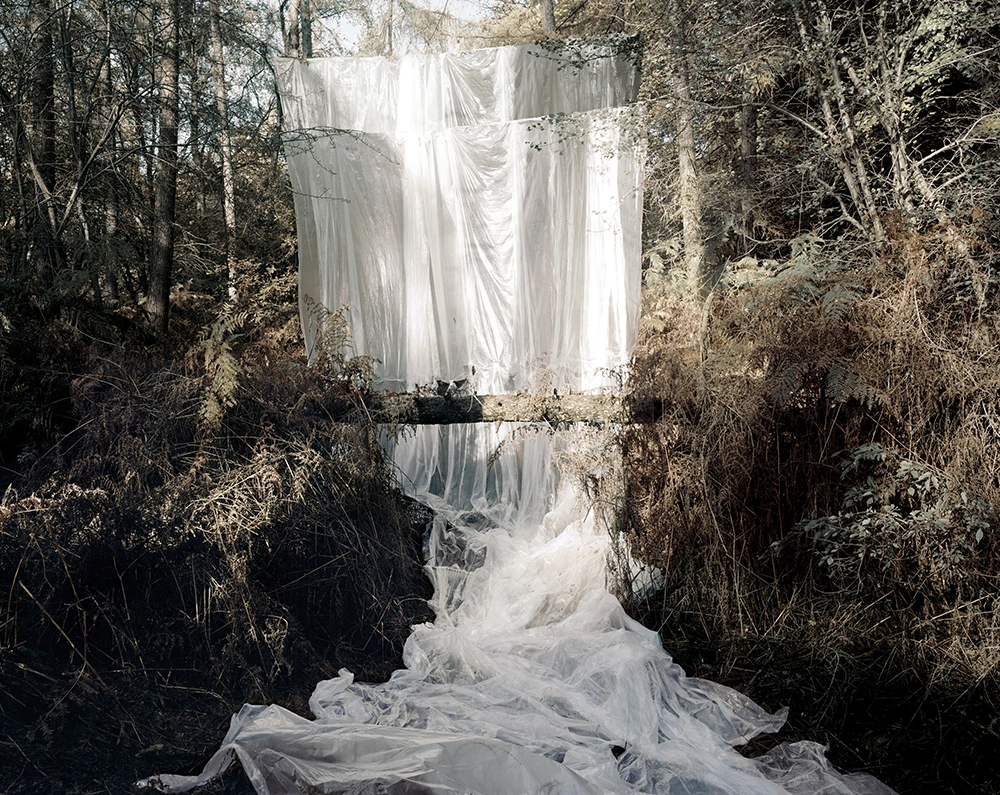
Goudal was already building landscapes for the camera in her early photographs. In Cascade (2009), she arranged protective plastic sheeting in a wood to resemble a waterfall. She later recalled spending two days there with a friend and becoming unsure whether the picture worked. A man arrived with his children and asked what they were doing on his land. When she showed them the photograph, the children immediately recognised a waterfall.
Material: Filming the collapse
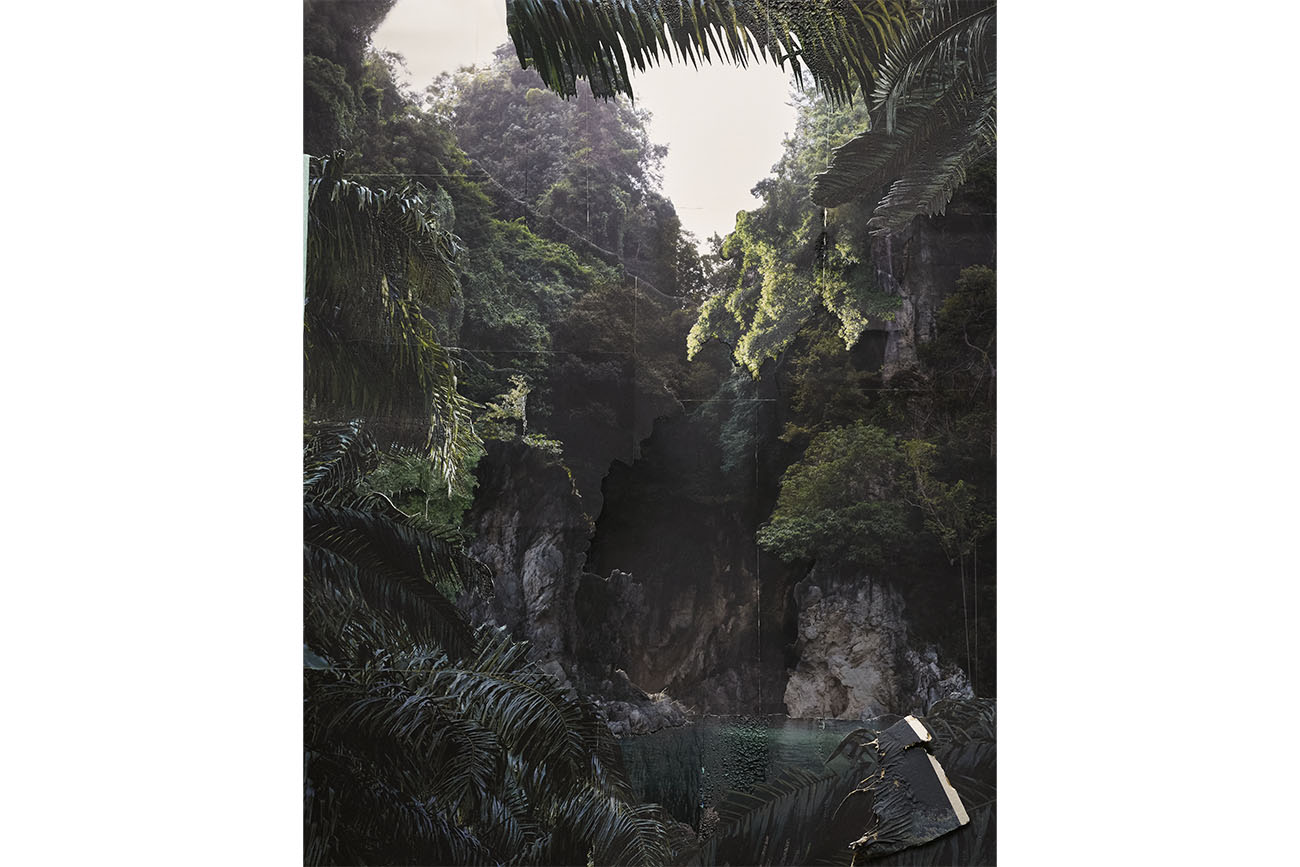
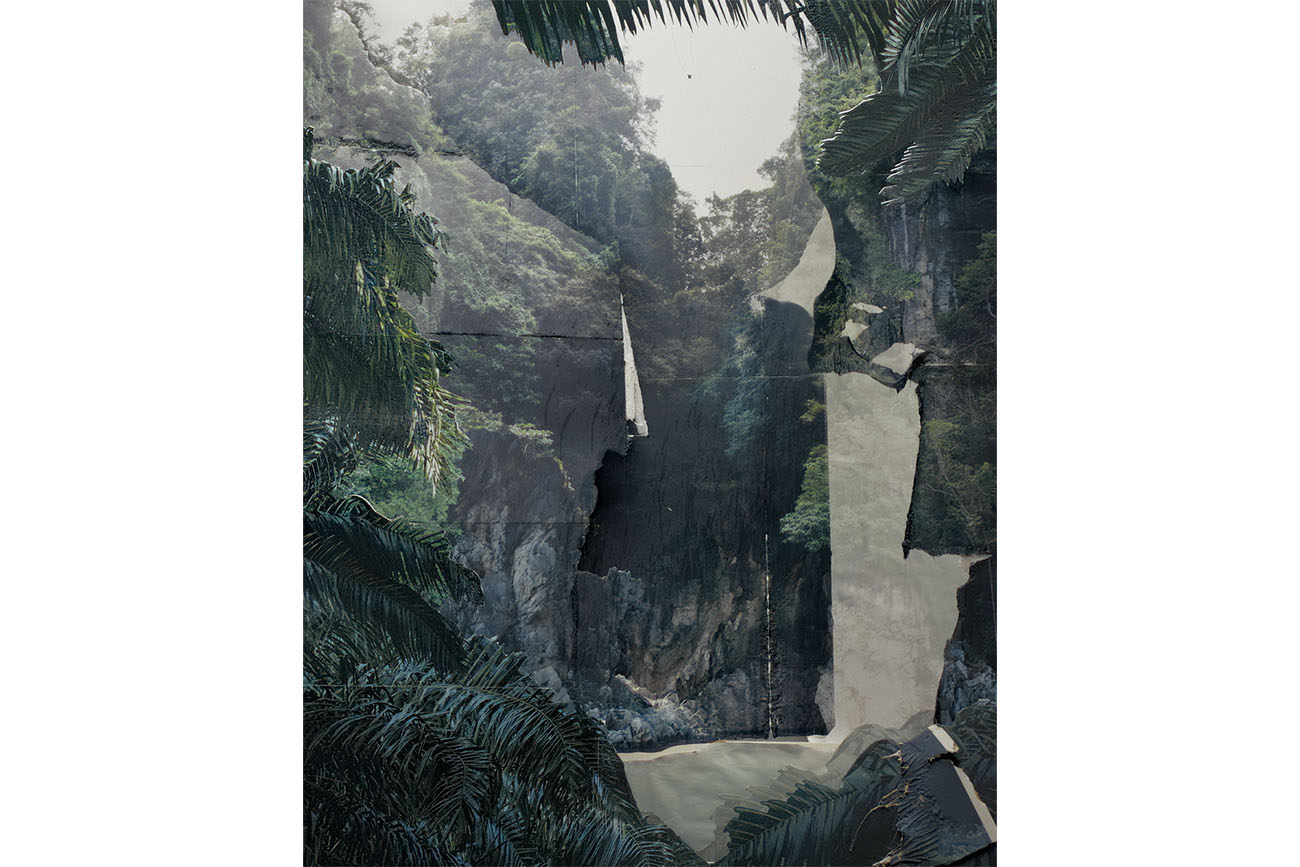
For Supra Strata, Goudal chose black polystyrene partly for the way it runs as it softens, which reminded her of oil. It carries the photographs and also determines how they break up. A rigid section becomes pliable, folds over, or drops out of the view. The printed rock and foliage move with it.
The dissolution was filmed in one continuous take. Goudal describes the shoot as a performance: she prepares the construction, but cannot predict exactly how each part will give way. Some changes are abrupt; others are slow enough to watch a small opening widen through the image. The visible supports and empty spaces are part of what she allows us to see.
Context: Reading the layers
Her interest in geological time developed after seeing La Glace et le Ciel, Luc Jacquet’s 2015 documentary about the glaciologist Claude Lorius. She was struck by the ice cores: drilling deeper meant reaching further into the past. She went on to experiment with paper that dissolved and sets that came apart, revealing another image behind them.
Supra Strata draws more specifically on stratigraphy, the study of rock layers, and on plastiglomerates. In 2014, geologist Patricia Corcoran, marine researcher Charles Moore, and artist Kelly Jazvac described examples from Kamilo Beach in Hawai‘i: melted plastic binding together rock, sand, and other debris. They proposed that these mixtures could survive in the geological record. The plastic objects we use and discard might eventually be identifiable within a new kind of stone.
She describes the film as a passage from night towards daylight, with brighter images appearing as the darker foregrounds dissolve.
Sound and scale
The soundtrack is made afterwards. Goudal’s shoots are full of activity and people calling to one another, so their live sound would tell a very different story. Working with a sound specialist, she can make a light surface seem heavy or give a falling fragment more force than it had in the studio.
Chloé Thévenin contributed the music for Supra Strata. For its 2024 Centre Pompidou presentation, Thibaut Javoy made a quadriphonic mix, distributing the sound across four channels.
The recording could not load. Watch at Universes in Universe.
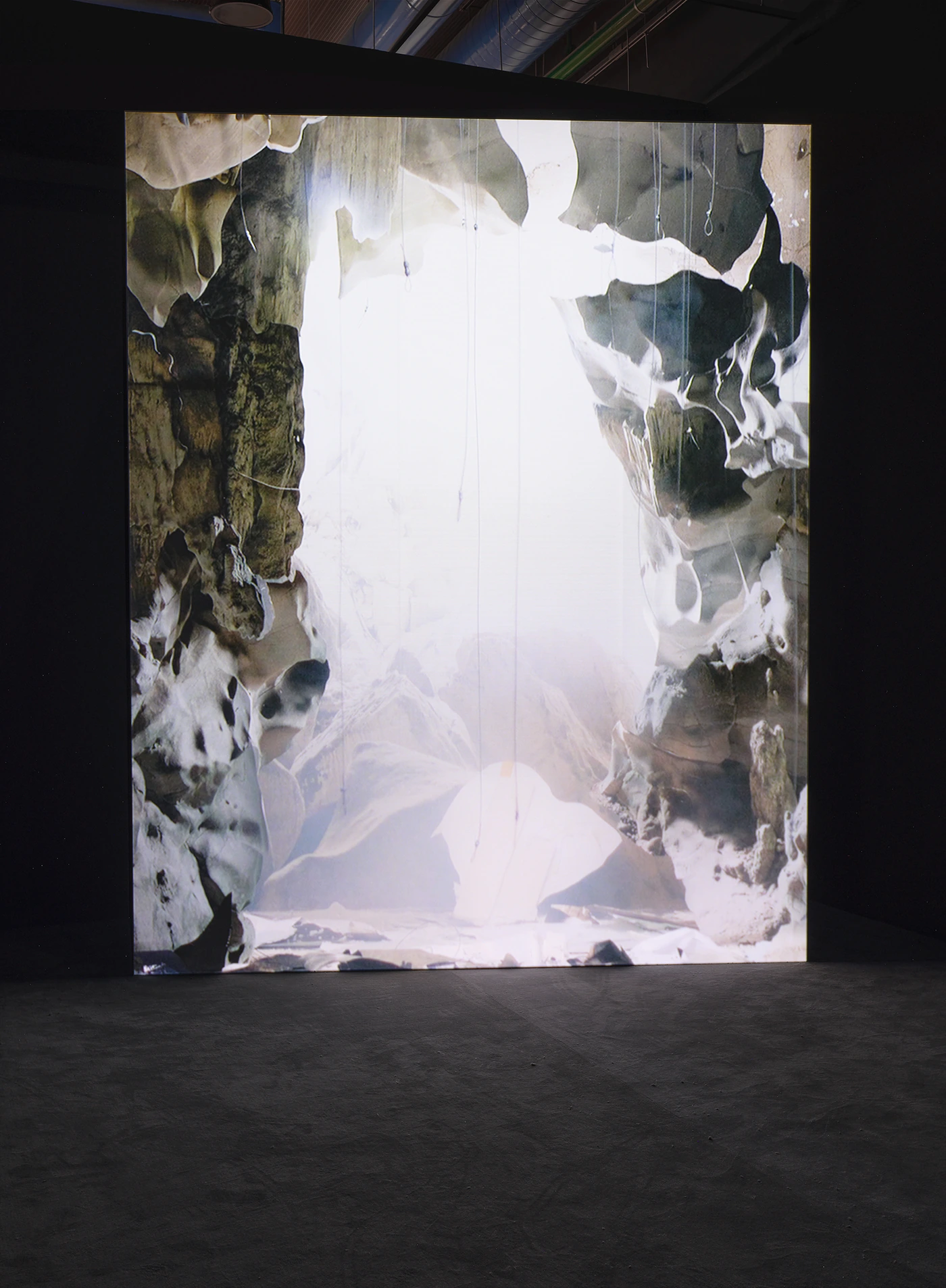
Goudal connects the vertical format with painting and the movement of water through a landscape. In the Pompidou installation, the projection stands close to the floor, with a bench facing it.
Reflection: In perspective
Seeing the set makes the construction of the landscape easier to understand. The ladders, stands, and separate sheets do not spoil the landscape. They give us a better sense of the judgement involved in making it convincing, and of how little has to move for that view to break up. The photographs of the set are worth seeing alongside the finished film.
The choice of polystyrene is the decision we keep coming back to. Goudal needs it to hold a carefully assembled image, then lets its response to acetone determine what happens on camera. Months of preparation lead to a shoot she cannot entirely direct. Keeping the dissolution in one continuous take lets us follow the small, uneven changes that editing could otherwise conceal. The photographs are precise, but the behaviour of their supports leaves room for something unplanned.
Behind the work
Supra Strata
- Artist
- Noémie Goudal
- Work
- Supra Strata, 2024
- Format
- Single-channel HD video, 17 minutes 52 seconds
- Music
- Chloé Thévenin
- Quadriphonic mix
- Thibaut Javoy, Centre Pompidou presentation, 2024
- Production
- Edel Assanti, Fondation Thalie, Fondation des Artistes
- Additional seed funding
- Derwent London
- Cinematography
- Julien Malichier
Sources
| Source | Title |
|---|---|
| Derwent London | Noémie Goudal: Supra Strata |
| Royal Society of Chemistry | Dissolving polystyrene in acetone |
| Compelling | Noémie Goudal, bonus conversation |
| Dapper Dan | Noémie Goudal in conversation with Kim Laidlaw |
| Le Grand Tour | Noémie Goudal |
| GSA Today | An anthropogenic marker horizon in the future rock record |
| Thibaut Javoy | 3D Sound |
| White Cube | Supra Strata |
| Universes in Universe | Noémie Goudal, Sharjah Biennial 16 |
| 200% / Edel Assanti | Noémie Goudal: Is the Earth flat? |
| CNRS | Claude Lorius, le film de sa vie |